

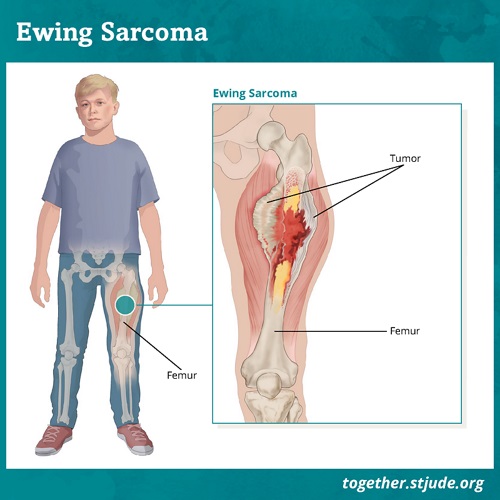
Ewing sarcoma is a type of cancer that develops in the bones or in the soft tissues surrounding the bones. It most commonly affects children and adolescents.
This tumor is named after Dr. James Ewing, an American pathologist who first described this type of cancer in the 1920s. Ewing sarcoma can develop anywhere in the body, but it most commonly affects the arms, legs, ribs, spine, and pelvis.
Treatment for Ewing sarcoma may include a combination of chemotherapy, surgery, and/or radiation therapy. When the disease is diagnosed early and treated appropriately, many children and adolescents with Ewing sarcoma have a good chance of recovery.
Signs and Symptoms
Ewing sarcoma is often mistaken for sports-related pain or injuries because its symptoms can resemble the injuries commonly experienced by children and adolescents during physical activity.
Pain at the site of the tumor, along with swelling or warmth, is one of the main signs. The pain may become worse at night or during exercise, and the child may develop a limp several weeks after the pain begins. A low-grade fever may also occur.
If the cancer has spread to other parts of the body, such as the lungs or bone marrow (metastasis), symptoms may also develop in those areas. In some cases, the first sign of the disease may be a broken arm or leg that occurs without an obvious cause or after a minor injury. This happens because the cancer can weaken the bone and make it more susceptible to fracture.
A child experiencing any of these symptoms should be evaluated by a physician.
Diagnosis
To diagnose Ewing sarcoma, the physician will take the child's medical history and perform a physical examination. Imaging studies such as X-rays, MRI, or a bone scan may then be performed to evaluate abnormalities in the bone structure. A biopsy of the tumor tissue is required to establish the diagnosis.
In some cases, a needle biopsy is performed using a long needle to obtain a sample of the tumor. Alternatively, an open biopsy may be performed, during which a portion of the tumor is surgically removed. These procedures are performed in the operating room by a surgeon, with the child under general anesthesia.
If Ewing sarcoma is confirmed, additional imaging tests may be performed to determine whether the cancer has spread to other parts of the body. These tests may also be used to evaluate the function of vital organs such as the heart and kidneys and determine whether the child can safely tolerate the planned treatment.
Once treatment begins, the medical team closely monitors the child and may perform additional tests to assess the response to treatment and determine whether the cancer is still progressing or spreading.
Chemotherapy and Radiation Therapy
Treatment for Ewing sarcoma depends on several factors, including the size and location of the tumor and whether the cancer has spread.
Regardless of the tumor's characteristics, children with Ewing sarcoma generally receive chemotherapy to shrink the tumor before surgery or radiation therapy and to reduce the risk of cancer cells spreading to other parts of the body. Chemotherapy is also given after the tumor has been removed to help eliminate any remaining cancer cells and reduce the risk of recurrence.
When surgery is required, radiation therapy may be used to control or shrink the tumor when appropriate. If the tumor is located in an area where surgery would be particularly difficult or risky, radiation therapy may be considered as an alternative to surgery.
Dr. Neda Ashayeri
Pediatric Hematologist & Oncologist
Reproduction of this content is permitted with proper attribution to the author and a link to the website.